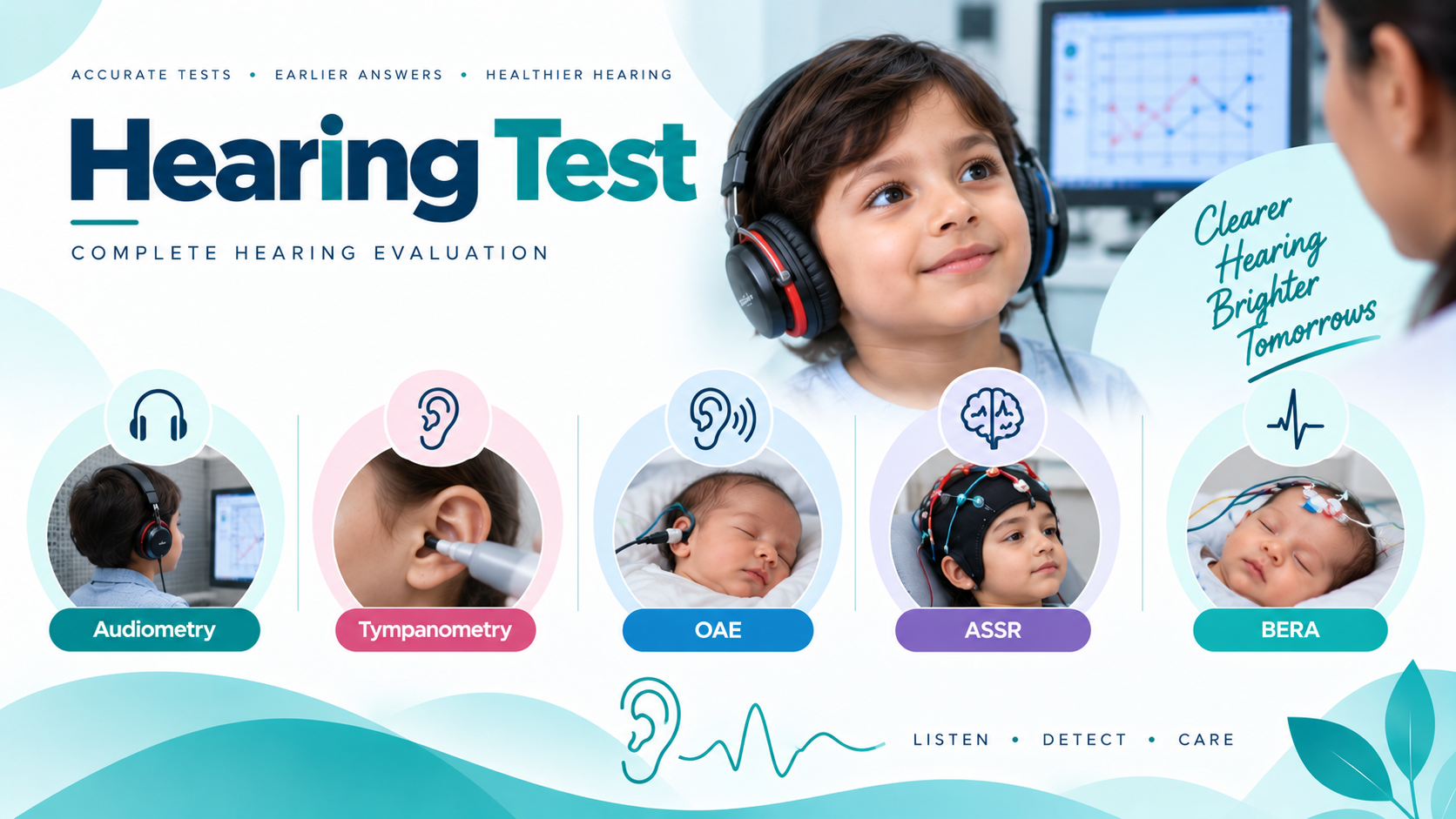
Hearing is essential for communication, learning, and everyday life. Hearing difficulties can occur at any age due to ear infections, ageing, noise exposure, congenital conditions, or other ear-related problems. A hearing test helps determine whether hearing loss is present and identifies its type and severity.
At Mahanandan Super Speciality Hospital, Greater Noida, Dr. Ashwani Kumar, ENT specialist, provides comprehensive evaluation and guidance for patients requiring hearing assessment. Depending on age, symptoms, and clinical findings, different tests such as Audiometry, Tympanometry, OAE, ASSR, and BERA may be recommended.
Pure Tone Audiometry
Pure Tone Audiometry (PTA) is a commonly performed hearing test for adults and older children. It measures the softest sounds a person can hear at different frequencies.
Audiometry helps assess:
- Degree of hearing loss
- Hearing ability in each ear
- Type of hearing loss
- Need for further evaluation or hearing rehabilitation
It may be recommended for people who have difficulty following conversations, frequently increase the volume of the television, or struggle to hear in noisy environments.
Tympanometry
Tympanometry evaluates the condition and functioning of the middle ear by measuring the movement of the eardrum in response to changes in air pressure.
It can help identify problems such as middle-ear fluid, eardrum abnormalities, ear pressure, or other conditions that may contribute to hearing difficulties.
Otoacoustic Emissions (OAE)
Otoacoustic Emissions (OAE) is an objective test that assesses the response of the inner ear, particularly the cochlea, to sound. It is widely used for newborn and infant hearing screening because the patient does not need to actively respond.
OAE may also be useful when evaluating children or patients who cannot reliably participate in conventional hearing tests.
ASSR Hearing Test
Auditory Steady-State Response (ASSR) is an objective hearing assessment that helps estimate hearing sensitivity when behavioral hearing tests are difficult to perform reliably.
It can be particularly useful for infants, young children, and individuals who cannot provide consistent responses during standard audiometry.
BERA Test
Brainstem Evoked Response Audiometry (BERA), also called an auditory brainstem response test, measures electrical activity along the auditory pathway and brainstem following sound stimulation.
BERA may be recommended for infants and young children, patients unable to respond reliably to conventional tests, or selected cases requiring objective assessment of the auditory pathway.
Why Are Hearing Tests Important?
Early hearing assessment can help detect hearing problems and guide appropriate management. In children, timely identification of hearing loss is particularly important because hearing contributes significantly to speech, language development, learning, and communication.
The appropriate test depends on the patient's age, symptoms, medical history, and ENT examination.
Hearing Test In Greater Noida
Dr. Ashwani Kumar at Mahanandan Super Speciality Hospital, Greater Noida, provides evaluation for patients with hearing-related concerns. Based on individual requirements, patients may undergo audiometry, tympanometry, OAE, ASSR, or BERA for a detailed assessment of hearing function.
If you or your child is experiencing hearing difficulties, delayed speech, recurrent ear infections, or other hearing-related concerns, timely evaluation can help identify the problem and support appropriate care.
For hearing tests in Greater Noida, consult Dr. Ashwani Kumar at Mahanandan Super Speciality Hospital for personalized ENT and hearing evaluation.